Monday, March 29, 2010

Where to publish...
First--- It's never too early to try to get published and everyone gets rejected.
That said, choosing the right journal can determine when and if your work is accepted. Choosing a journal to submit your work to is a delicate balance between the journal's impact factor, turnover time, and acceptance rates. Think about the above factors and also who you want to reach with your work. Do not be afraid to contact editors if your paper has been in review for over 4 months with no word (this might vary a bit depending on how many issues the journal puts out per year). You also should carefully read the "Guidelines for Authors" and "Mission and Scope" for journals that you are interested in. It is rare (but not impossible) to get published in the top journals early in your career.
Compare the following two descriptions:
1) The "classic"- Ecology --- http://www.esapubs.org/esapubs/journals/ecology.htm
2) A new "upstart" journal- Ideas in Ecology and Evolution--- http://library.queensu.ca/ojs/index.php/IEE
***Note that an increasing trend in the top journals is short concise articles***
Resources
http://www.scu.edu/SCU/Departments/EnvironmentalStudies/whoweare/docs/Where%20to%20publish%28Black%29.htm
http://www.ecobias.org/resources_files/Aarssenetal2008.pdf
That said, choosing the right journal can determine when and if your work is accepted. Choosing a journal to submit your work to is a delicate balance between the journal's impact factor, turnover time, and acceptance rates. Think about the above factors and also who you want to reach with your work. Do not be afraid to contact editors if your paper has been in review for over 4 months with no word (this might vary a bit depending on how many issues the journal puts out per year). You also should carefully read the "Guidelines for Authors" and "Mission and Scope" for journals that you are interested in. It is rare (but not impossible) to get published in the top journals early in your career.
Compare the following two descriptions:
1) The "classic"- Ecology --- http://www.esapubs.org/esapubs/journals/ecology.htm
2) A new "upstart" journal- Ideas in Ecology and Evolution--- http://library.queensu.ca/ojs/index.php/IEE
***Note that an increasing trend in the top journals is short concise articles***
Resources
http://www.scu.edu/SCU/Departments/EnvironmentalStudies/whoweare/docs/Where%20to%20publish%28Black%29.htm
http://www.ecobias.org/resources_files/Aarssenetal2008.pdf
Sunday, March 28, 2010
Nature doing it's thing in Costa Rica

Three toed sloth: Mutualism - Symbiotic cyanobacteria live in the sloth's fur. The bacteria provide camouflage for the sloth. The sloth provides a home for the bacteria.

White faced capuchins: Anti-predatory behavior - As I approached, one mounted the other in order to look larger.

Layers of the rainforest: Competition for sunlight - Saplings in the understory shoot up when larger trees fall. Vines and lianas wrap around tall trees. Epiphytes grow on the nooks of trees.


Bromeliad ecosystems: Mutualism - The leaves form a vase like shape and fill with water. Critters (like the one in the top photo), live in the bromeliad and release nutrients.
Leaf-Cutter Ants
We found leaf-cutter ants in every location that we visited. They are so ubiquitous in Costa Rica that one of our hotel owners had a metal sculpture of them on her welcome sign.

Here's my video of the ants at work.

Here's my video of the ants at work.
Anti-Predator Adaptations in Costa Rica
So, Oriana and I wanted to share some of the amazing things that we found in Costa Rica that applies to the topics we have covered in class. We traveled to a number of different locations and experienced a lot of different microclimates. Although we were there during the dry season we went to higher altitude cloud forests (with tons of rain), to very arid farmland and forests to a super humid nature reserve right along the Pacific ocean.
Here are a few of the anti-predator adaptations that we found (if anyone wants to go ahead and identify these organisms, feel free).
In most locations we saw plants with structure defenses in the form of thorns and spines.


We also found a number of animals with cryptic coloration. The coloration used by these animals varied based on the location that we found them.
This green lizard was in a cloud forests that had a lot of green and brown vegetation on the ground.

While this brown lizard was found in the dry and hot Pacific coast nature reserve.
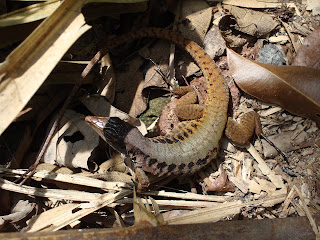 This lizard was found in the same park as the brown one (very dry and sandy location).

We also found many blue morpho butterflies that have warning eyespots when their wings are closed.

Location, location, location!!! Huge termite mound high in a tree, possibly to avoid predation?

In response to plant defenses, this leaf miner insect left behind a pretty image.

Here are a few of the anti-predator adaptations that we found (if anyone wants to go ahead and identify these organisms, feel free).
In most locations we saw plants with structure defenses in the form of thorns and spines.


We also found a number of animals with cryptic coloration. The coloration used by these animals varied based on the location that we found them.
This green lizard was in a cloud forests that had a lot of green and brown vegetation on the ground.

While this brown lizard was found in the dry and hot Pacific coast nature reserve.
 This lizard was found in the same park as the brown one (very dry and sandy location).
We also found many blue morpho butterflies that have warning eyespots when their wings are closed.

Location, location, location!!! Huge termite mound high in a tree, possibly to avoid predation?

In response to plant defenses, this leaf miner insect left behind a pretty image.

Thursday, March 18, 2010
On Rarity and Richness
Hi All! Happy spring break and happy St. Patty's Day!
Does anyone have the ability to access the full article below? Can we access it through Fordham? It appears pretty relevant to class and reflects a few conversations that have gone on. I've had no luck tracking down who the two elusive researchers from UCAL Davis are, so I can't find the original paper (if there is one?)
Enjoy the rest of break!
http://www.sciencemag.org/cgi/content/short/327/5971/1318
An interview with the author starts on pg 6 - http://www.sciencemag.org/cgi/data/327/5971/1395-b/DC1/1
Does anyone have the ability to access the full article below? Can we access it through Fordham? It appears pretty relevant to class and reflects a few conversations that have gone on. I've had no luck tracking down who the two elusive researchers from UCAL Davis are, so I can't find the original paper (if there is one?)
Enjoy the rest of break!
http://www.sciencemag.org/cgi/content/short/327/5971/1318
An interview with the author starts on pg 6 - http://www.sciencemag.org/cgi/data/327/5971/1395-b/DC1/1
Wednesday, March 10, 2010
Studying for the Midterm
How’s the studying going? Hopefully well! Earlier today there was a productive study session in LH 370. Here’s what we learned:
 Be cautious, however, if your study partner tries to eat one of the text books.
 It’s always a good idea to consult the text books!
Be cautious, however, if your study partner tries to eat one of the text books. Those zero growth isoclines get a bit trippy if you stare at them long enough… carrying capacity over alpha is greater than what?
 After too long, we all find ourselves passing out on the desk using Peter Morin’s Community Ecology text as a pillow, don’t we? The solution – espresso shots and chocolate covered coffee beans!
Happy Studying!
Subscribe to:
Posts (Atom)